Pharmaceutical intermediates

Home - Products - Pharmaceutical intermediates

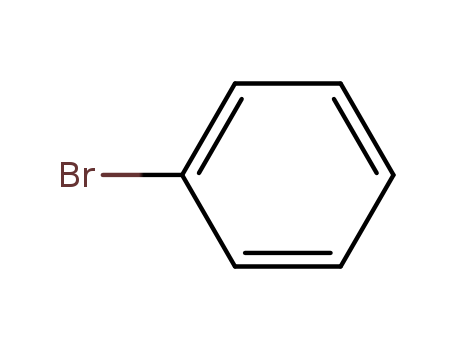
Bromobenzene

  • Product Name: Bromobenzene
  • CasNo: 108-86-1
  • Purity:
  • Appearance: colourless liquid

Mobile/Wechat/WhatsApp: Chen Shihuai +86-13961989018  Yang Zhengquan +86-13921613169   Chen Yi +86-13962066393

Email:

Inquiry

CasNo: 108-86-1

Molecular Formula: C6H5Br

Appearance: colourless liquid

Factory Sells Best Quality Bromobenzene 108-86-1 with ISO standards

  • Molecular Formula:C6H5Br
  • Molecular Weight:157.01
  • Appearance/Colour:colourless liquid 
  • Vapor Pressure:10 mm Hg ( 40 °C) 
  • Melting Point:-31 °C 
  • Refractive Index:n20/D 1.559(lit.)  
  • Boiling Point:154.219 °C at 760 mmHg 
  • Flash Point:51.111 °C 
  • PSA:0.00000 
  • Density:1.486 g/cm3 
  • LogP:2.44910 

Bromobenzene(Cas 108-86-1) Usage

Physical properties

Mobile, clear, colorless to pale yellow liquid with an aromatic odor. The reported odor threshold is 4.6 ppm (Mateson, 1955). Insoluble in water, soluble in benzene, alcohol, ether, chlorobenzene and other organic solvents. It is irritating to the skin and anesthetic to the nerves. Its toxicity is stronger than chlorobenzene. Inhalation of its vapors can cause anemia and damage the liver.

Definition

ChEBI: Bromobenzene is the simplest member of the class of bromobenzenes, that is benzene in which a single hydrogen has been substituted by a bromine. A liquid at room temperature (m.p. -30℃; b.p.760 156℃), it is used as a solvent, particularly for large-scale crystallisations, and for the introduction of phenyl groups in organic synthesis. It has a role as a non-polar solvent, a hepatotoxic agent and a mouse metabolite. It is a member of bromobenzenes, a bromoarene and a volatile organic compound.

Application

The compound is employed as a starting material in organic syntheses in which a Grignard intermediate (phenyl magnesium bromide) is used. The material is a chemical precursor for certain agricultural products and has been used as an additive to motor oils. Bromobenzene has also been used as a high-density solvent for chemical recrystallization processes. especially for crystallizations on a large scale and where a heavy liquid is desirable.

Preparation

Bromobenzene is obtained by reacting benzene with bromine. First add iron powder and benzene into the reactor, slowly add bromine under stirring, keep the reaction at 70-80°C for 1 h after adding, the obtained crude product is washed with water and 5% sodium hydroxide solution, left to stand for stratification, distillation, Drying, filtering, and finally fractional distillation under constant pressure, taking the fraction at 155-157°C to obtain the finished product.

Synthesis Reference(s)

The Journal of Organic Chemistry, 30, p. 304, 1965 DOI: 10.1021/jo01012a512Tetrahedron Letters, 26, p. 1935, 1985 DOI: 10.1016/S0040-4039(00)98345-X

General Description

Mobile clear colorless liquid with a pungent odor. Flash point 124°F. Denser than water and insoluble in water. Hence sinks in water. Vapors are heavier than air. A skin irritant.

Air & Water Reactions

Flammable. Insoluble in water.

Reactivity Profile

Bromobenzene may be sensitive to light. May react with oxidizing agents .

Health Hazard

Contact with liquid causes irritation of eyes and mild irritation of skin. Ingestion causes mild irritation of mouth and stomach.

Fire Hazard

Moderate fire risk. Special Hazards of Combustion Products: Irritating hydrogen bromide and other gases may be produced in fire.

Biochem/physiol Actions

Bromobenzene induces hepatic necrosis via the formation of a reactive metabolite that arylates vital cellular macromolecules.

Safety Profile

Moderately toxic by ingestion, subcutaneous, and intraperitoneal routes. LWdly toxic by inhalation. An eye and mucous membrane irritant. Mutation data reported. Flammable liquid when exposed to heat, sparks, or flame. Can react with oxidtzing materials. To fight fire, use water to blanket fire, foam, CO2, water spray or mist, dry chemical. Violent reaction with bromobutane + sodium when heated above 30℃. When heated to decomposition it emits toxic fumes of Br-. See also BROMIDES.

Source

No MCLs, MCLGs, or DWELs have been proposed (U.S. EPA, 2000). Storm water runoff, waste motor oils, improper disposal of laboratory solvent containing bromobenzene (quoted, Verschueren, 1983)

Environmental Fate

Bromobenzene will volatilize from dry surfaces, due to its vapor pressure of 4.18mmHg at 25°C, and therefore will exist as a vapor in the environment. Bromobenzene will undergo little hydrolysis in water and little biodegradation by aquatic microorganisms. Bromobenzene is not expected to adsorb to sediment from water due to its soil sorption constant (Koc) of 150 and water solubility of 446 mg l-1. It is also expected to have a high mobility in soil and volatilize easily from moist surfaces due to its Henry’s law constant of 2.47×10⁻³ atmm3 mol-1 at 25°C. Bioconcentration factors range from low values of 8.8 in carp to moderately high values of 190 in algae.

Metabolic pathway

Bromobenzene and chlorobenzene are metabolized by human and mouse hepatic microsomes to two different epoxide intermediates, which rearrange to form either o- or p-bromo- and o- or p-chlorophenols, respectively. Humans preferentially metabolize halobenzenes through the hepatotoxic 3,4-epoxide pathway, suggesting that humans may be more susceptible than mice to halobenzene-induced hepatotoxicity.

Purification Methods

Wash bromobenzene vigorously with conc H2SO4, then 10% NaOH or NaHCO3 solutions, and H2O. Dry it with CaCl2 or Na2SO4, or pass it through activated alumina, before refluxing with, and distilling from, CaH2, using a glass helix-packed column. [Beilstein 5 IV 670.]

Toxicology

The acute toxicity of bromobenzene is lowin test animals. The toxic symptoms includesomnolence, respiratory stimulation, and muscle contraction. The oral LD50 value in rats is2700 mg/kg.

InChI:InChI=1/C6H5Br/c7-6-4-2-1-3-5-6/h1-5H

108-86-1 Relevant articles

Comments on a Conversion of Epoxides to Halohydrins with Elemental Halogen Catalyzed by Phenylhydrazine: Tandem Electrophilic Halogenation of Aromatic Compounds and Epoxide Ring Opening to Halohydrins

Soroka, Miroslaw,Goldeman, Waldemar,Malysa, Piotr,Stochaj, Monika

, p. 2341 - 2344 (2003)

The halogenation of aromatic compounds b...

A convenient new method for the bromination of deactivated aromatic compounds

Duan, Jianxin,Zhang, Lian Hao,Dolbier Jr., William R.

, p. 1245 - 1246 (1999)

Treatment of deactivated aromatic compou...

Photoelectrochemistry with Quinone Radical Anions-Photoassisted Reduction of Halobenzenes and Carbonyl Compounds

Robertson, Peter K. J.,Eggins, Brian R.

, p. 1829 - 1832 (1994)

Photoexcited electrochemically generated...

C?I-Selective Cross-Coupling Enabled by a Cationic Palladium Trimer

Diehl, Claudia J.,Scattolin, Thomas,Englert, Ulli,Schoenebeck, Franziska

, p. 211 - 215 (2019)

While there is a growing interest in har...

Directly Observed Reductive Elimination of Aryl Halides from Monomeric Arylpalladium(II) Halide Complexes

Roy, Amy H.,Hartwig, John F.

, p. 13944 - 13945 (2003)

Monomeric, three-coordinate arylpalladiu...

Vibrational Spectroscopy and Photodissociation Properties of Ions As Determined by Two-Laser Photodissociation Techniques.

Honovich, Jeffrey P.,Dunbar, Robert C.

, p. 3755 - 3758 (1983)

Iodobenzene, bromobenzene, and m-iodotol...

Effects of Solvent and Additives on the Rearrangement Pathway of the Seyferth Reaction

Lambert, Joseph B.,Boch, Richard J.,Larson, Eric G.

, p. 3054 - 3059 (1985)

The Seyferth reagent has dual reactivity...

A study on Zr-Ir multiple bonding active for C-H bond cleavage

Oishi, Masataka,Oshima, Masato,Suzuki, Hiroharu

, p. 6634 - 6654 (2014)

Zr-Ir hydrido complexes with ansa-(cyclo...

The Addition Reaction of Benzynes Generated Electrochemically from Dihalobenzenes with Tertiary Amines

Egashira, Naoyoshi,Takenga, Jun,Hori, Fumikai

, p. 2671 - 2673 (1987)

The electroreduction of dihalobenzenes w...

ON THE ABSOLUTE REACTIVITY OF ARYL CATIONS: SELECTIVITY TOWARD HALIDE IONS AS A FUNCTION OF VISCOSITY

Lorand, John P.

, p. 7337 - 7340 (1989)

The selectivities toward bromide and chl...

Generation, structure, and reactivity of o-iodobenzoyloxyl radicals. Pulsed laser photolysis of 1-(o-halobenzoyloxy)-2-pyridones

Hashimoto, Ji-Ichiro,Segawa, Katsunori,Itoh, Hiroki,Sakuragi, Hirochika

, p. 362 - 363 (2000)

The transient absorption spectrum of o-i...

Photochemically Switching Diamidocarbene Spin States Leads to Reversible Büchner Ring Expansions

Perera, Tharushi A.,Reinheimer, Eric W.,Hudnall, Todd W.

, p. 14807 - 14814 (2017)

The discovery of thermal and photochemic...

Nucleophilic substitution of hydrogen in naphthalene by chloride (Cl -) in ionic liquids

Shi, Shen Yi,Kong, Ai Guo,Zhao, Xin Hua,Ding, Han Ming,Yang, Fan,Shan, Yong Kui

, p. 147 - 150 (2011)

Nucleophilic aromatic substitution of hy...

Hydroxyl radical induced reactions in aqueous solutions of halogenated benzenes: Effect of electronegativity of halogen

Mohan, Hari,Mittal, Jai P.

, p. 599 - 607 (2002)

The .OH radicals, generated by radiolysi...

Cope rearrangement versus a novel tandem retro-diels-alder-diels-alder reaction with role reversal

Su, Kuan-Jen,Mieusset, Jean-Luc,Arion, Vladimir B.,Brecker, Lothar,Brinker, Udo H.

, p. 113 - 115 (2007)

A reinvestigation of the thermolysis of ...

REDUCTION BY A MODEL OF NAD(P)H. 42. DIRECT EVIDENCE FOR ONE ELECTRON TRANSFER MECHANISM IN THE REDUCTION OF ARENEDIAZONIUM SALTS.

Yasui, Shinro,Nakamura, Kaoru,Ohno, Atsuyoshi

, p. 3331 - 3334 (1983)

Arenediazonium salts are reduced by an N...

Through-Space Activation Can Override Substituent Effects in Electrophilic Aromatic Substitution

Guan, Liangyu,Holl, Maxwell Gargiulo,Pitts, Cody Ross,Struble, Mark D.,Siegler, Maxime A.,Lectka, Thomas

, p. 14913 - 14916 (2017)

Electrophilic aromatic substitution (EAS...

-

Ainley,Challenger

, p. 2171,2176 (1930)

-

-

Beringer et al.

, p. 141,143 (1956)

-

Bromination of Deactivated Aromatics Using Potassium Bromate

Harrison, J.J.,Pellegrini, J.P.,Selwitz, C.M.

, p. 2169 - 2171 (1981)

-

Pd-catalyzed reduction of aryl halides using dimethylformamide as the hydride source

Zawisza, Anna Maria,Muzart, Jacques

, p. 6738 - 6742 (2007)

The Pd-catalyzed homocoupling of aryl ha...

-

Summers,Larson

, p. 4498 (1952)

-

Properties of PTFE tape as a semipermeable membrane in fluorous reactions

Parsons, Brendon A.,Smith, Olivia Lin,Chae, Myeong,Dragojlovic, Veljko

, p. 980 - 993 (2015)

In a PTFE tape phase-vanishing reaction ...

Bromine and iodine-cucurbit[6]uril complexes: Preparation and applications in synthetic organic chemistry

Reddy,Cavallini,Demets,Silva

, p. 2262 - 2264 (2014)

Iodine and bromine inclusion compounds w...

-

Leicester

, p. 619 (1938)

-

-

Henry

, p. 1886,1888 (1971)

-

Photochemical Decomposition of Dibenzoyl Peroxide and Phenyl Benzoate in Solid KBr Matrix

Owen, David J.,O'Donnell, Jennifer,Schutt, Wendy,Morrow, Jeffrey,Li, Yuzhuo

, p. 6203 - 6207 (1993)

Physical and photochemical properties of...

-

Bunnett et al.

, p. 367 (1966)

-

-

Kohn,Mueller

, p. 407 (1909)

-

-

Rice,Morganroth

, p. 1388 (1956)

-

Noncatalytic bromination of benzene: A combined computational and experimental study

Shernyukov, Andrey V.,Genaev, Alexander M.,Salnikov, George E.,Rzepa, Henry S.,Shubin, Vyacheslav G.

, p. 210 - 225 (2016)

The noncatalytic bromination of benzene ...

-

Le Fevre,Markham

, p. 703 (1934)

-

Formation and Reactivity of the Radical Cation of Bromobenzene in Aqueous Solution: A Pulse Radiolysis Study

Mohan, Hari,Mittal, Jai P.

, p. 6519 - 6524 (1995)

A transient optical absorption band (λma...

-

Huyser,Wang

, p. 3901 (1968)

-

Radical Rearrangements of Bicyclohexane: Homolytic Substitution of a Cyclobutane Ring

Walton, John C.

, p. 1252 - 1254 (1987)

Bromine atoms react with bicyclohexane i...

Remarkably stable ortho-halophenylcopper reagents

Ebert, Greg W.,Pfennig, Deborah R.,Suchan, Scott D.,Donovan Jr., Thomas A.

, p. 2279 - 2282 (1993)

We wish to report the generation of rema...

Reactivity of alkali and alkaline earth metal tetrafluorobromates towards aromatic compounds and pyridine

Sobolev, Vasily I.,Filimonov, Victor D.,Ostvald, Roman V.,Radchenko, Vyacheslav B.,Zherin, Ivan I.

, p. 120 - 123 (2016)

The bromination activity of tetrafluorob...

-

Kohn,Fink

, p. 187 (1923)

-

Silk?Fibroin-Supported Palladium Catalyst for Suzuki-Miyaura and Ullmann Coupling Reactions of Aryl Chlorides

Albano, Gianluigi,Farinola, Gianluca M.,Giannini, Cinzia,Musio, Roberta,Omenetto, Fiorenzo G.,Rizzo, Giorgio,Sibillano, Teresa

supporting information, (2022/02/03)

Recently, we have reported the preparati...

Radical Hydrodehalogenation of Aryl Halides with H2 Catalyzed by a Phenanthroline-Based PNNP Cobalt(I) Complex

Iizuka, Kosuke,Ishizaka, Yusuke,Jheng, Nai-Yuan,Minami, Yasunori,Naganawa, Yuki,Nakajima, Yumiko,Sekiguchi, Akira

, p. 2320 - 2329 (2022/02/16)

Radical hydrodehalogenation of aryl hali...

Alternative method for the synthesis of triazenes from aryl diazonium salts

Abrams

, (2021/05/10)

An alternative mild method for access to...

METHOD FOR PRODUCING LITHIUM COMPOUND

-

Paragraph 0044; 0072-0092, (2021/01/29)

PROBLEM TO BE SOLVED: To provide a metho...

108-86-1 Process route

diethyl ether
60-29-7,927820-24-4

diethyl ether

phenyllithium
591-51-5

phenyllithium

1,1-dibromomethane
74-95-3

1,1-dibromomethane

bromobenzene
108-86-1,52753-63-6

bromobenzene

benzyl bromide
100-39-0

benzyl bromide

1,1'-(1,2-ethanediyl)bisbenzene
103-29-7

1,1'-(1,2-ethanediyl)bisbenzene

Conditions
Conditions Yield
zuletzt bei Raumtemperatur;
bromine
7726-95-6

bromine

acetic acid
64-19-7,77671-22-8

acetic acid

phenylboronic acid
98-80-6

phenylboronic acid

bromobenzene
108-86-1,52753-63-6

bromobenzene

hydrogen bromide
10035-10-6,12258-64-9

hydrogen bromide

Conditions
Conditions Yield
at 25 ℃; Rate constant;

108-86-1 Upstream products

  • 64146-90-3
    64146-90-3

    diphenylbromonium hexafluorophosphate

  • 71-43-2
    71-43-2

    benzene

  • 60-29-7
    60-29-7

    diethyl ether

  • 55919-47-6
    55919-47-6

    ethyl 2-bromo-3-oxo-3-phenylpropionate

108-86-1 Downstream products

  • 466-95-5
    466-95-5

    8β-chloro-4,5α-epoxy-3-methoxy-17-methyl-morphin-6-ene

  • 4096-21-3
    4096-21-3

    N-phenylpyrrolidine

  • 4096-20-2
    4096-20-2

    N-phenyl piperidine

  • 92-53-5
    92-53-5

    4-Phenylmorpholine

Leave Your Message

Relevant Products