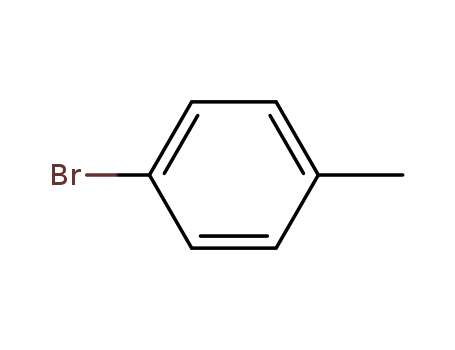
Novel site-specific one-step bromination of substituted benzenes
Srivastava, Sanjay K.,Chauhan, Prem Man Singh,Bhaduri, Amiya P.
, p. 2679 - 2680 (1996)
Regiospecific bromination of benzene der...
A simple and improved procedure for selective ring bromination of alkyl-substituted aromatic hydrocarbons on the surface of alumina
Ranu,Sarkar,Chakraborty
, p. 1095 - 1099 (1992)
Highly selective ring bromination of alk...
Selective Halogenation of Aromatic Hydrocarbons with Alumina-Supported Copper(II) Halides
Kodomari, Mitsuo,Satoh, Hiroaki,Yoshitomi, Suehiko
, p. 2093 - 2094 (1988)
-
Induced bromination of aromatic hydrocarbons by alkali metals bromides and sodium hypochlorite
Sadygov,Alimardanov,Chalabiev
, p. 1631 - 1636 (2005)
Induced bromination of aromatic compound...
-
Brown,McGary
, p. 2310 (1955)
-
-
de la Mare,Harvey
, p. 36,38 (1956)
-
Bromination of alkylbenzenes in 1-butyl-3-methylimidazolium bromide and its dibromide complex
Gruzdev,Virzum,Krylov
, p. 263 - 267 (2010)
Alkylbenzenes were subjected to brominat...
Deoxygenation of carbonyl compounds using an alcohol as an efficient reducing agent catalyzed by oxo-rhenium complexes
Bernardo, Joana R.,Fernandes, Ana C.
, p. 2675 - 2681 (2016)
This work describes the first methodolog...
Regioselective bromination of aromatic compounds with Br 2/SO2Cl2 over microporous catalysts
Gnaim, Jallal M.,Sheldon, Roger A.
, p. 4465 - 4468 (2005)
A new selective brominating system Br2/S...
A new method of bromination of aromatic rings by an iso-amyl nitrite/HBr system
Gavara, Laurent,Boisse, Thomas,Rigo, Beno?t,Hénichart, Jean-Pierre
, p. 4999 - 5004 (2008)
A mixture of iso-amyl nitrite/HBr is sho...
Reactivities of Several Nucleophiles toward 4-Methylbenzyne in Very Hot Water
Zoratti, Mario,Bunnett, J. F
, p. 1776 - 1782 (1980)
By means of competition experiments, the...
-
Henne,Zimmer
, p. 1362 (1951)
-
Halogenation of Aromatic Compounds by using Sodium Perborate as an Oxidant
Deshmukh, Anjali P.,Padiya, Kamlesh J.,Jadhav, Vidyadhar K.,Salunkhe, Manikrao M.
, p. 828 - 829 (1998)
A facile method for the halogenation of ...
Bipyridinium and Phenanthrolinium Dications for Metal-Free Hydrodefluorination: Distinctive Carbon-Based Reactivity
Burton, Katherine I.,Elser, Iris,Waked, Alexander E.,Wagener, Tobias,Andrews, Ryan J.,Glorius, Frank,Stephan, Douglas W.
, p. 11730 - 11737 (2021)
The development of novel Lewis acids der...
Dynamics of endoergic substitution reactions. I. Br+chlorinated aromatic compounds
Robinson, Gary N.,Continetti, Robert E.,Lee, Yuan T.
, p. 6226 - 6237 (1988)
The endoergic substitution reactions Br ...
-
Brown,Stock
, p. 1421,1422 (1957)
-
Selective para-Bromination of Toluene catalysed by Na-Y Zeolite in the Presence of an Epoxide
Vega, Fernando de la,Sasson, Yoel
, p. 653 - 654 (1989)
Propylene oxide, serving as an HBr scave...
Halogenation Using N-Halogenocompounds. II. Acid Catalyzed Bromination of Aromatic Compounds with 1,3-Dibromo-5,5-dimethylhydantoin
Eguchi, Hisao,Kawaguchi, Hideichiro,Yoshinaga, Sachiyo,Nishida, Akiko,Nishiguchi, Takeshi,Fujisaki, Shizuo
, p. 1918 - 1921 (1994)
Ring bromination of aromatic compounds u...
Induced bromination of aromatic hydrocarbons with alkali metal bromides in the presence of oxidants
Sadygov,Alimardanov,Chalabiev
, p. 949 - 956 (2006)
The features of induced bromination of a...
Convenient Synthesis of Aryl Halides from Arylamines via Treatment of 1-Aryl-3,3-dialkyltriazenes with Trimethylsilyl Halides
Ku, Hao,Barrio, Jorge R.
, p. 5239 - 5241 (1981)
-
Synthesis of tin-containing cyclodextrins as potential enzyme models
Zhou, You,Marinescu, Lavinia,Pedersen, Christian Marcus,Bols, Mikael
, p. 6383 - 6389,7 (2012)
The synthesis and the characterization o...
Room-temperature catalytic hydrodefluorination of C(sp3)-F bonds
Scott, Valerie J.,Celenligil-Cetin, Remle,Ozerov, Oleg V.
, p. 2852 - 2853 (2005)
Room-temperature catalytic hydrodefluori...
Molecular structures of the metastable charge-transfer complexes of benzene (and toluene) with bromine as the pre-reactive intermediates in electrophilic aromatic bromination
Vasilyev, Alexandr V.,Lindeman, Sergey V.,Kochi, Jay K.
, p. 582 - 592 (2002)
Successful crystallization and X-ray cry...
-
Bunce
, p. 664,668 (1972)
-
1,3-dibromo-5,5-dimethylhydantoin, a useful reagent for aromatic bromination
Chassaing, Christophe,Haudrechy, Arnaud,Langlois, Yves
, p. 4415 - 4416 (1997)
1,3-dibromo-5,5-dimethylhydantoin (DBDMH...
OOxidative bromination of activated aromatic compounds using aqueous nitric acid as an oxidant
Joshi, Ashutosh V.,Baidossi, Mubeen,Mukhopadhyay, Sudip,Sasson, Yoel
, p. 568 - 570 (2004)
Oxidative bromination of activated aroma...
An efficient copper-catalysed aerobic oxybromination of arenes in water
Wang, Jian,Wang, Wei,Li, Jing-Hua
, p. 2124 - 2126 (2010)
An aerobic oxybromination of arenes cata...
Direct bromodeboronation of arylboronic acids with CuBr2 in water
Tang, Yan-Ling,Xia, Xian-Song,Gao, Jin-Chun,Li, Min-Xin,Mao, Ze-Wei
supporting information, (2021/01/05)
An efficient and practical method has be...
Poly-N-bromosulfonamide-melamine as a novel brominating reagent for regioselective ipso-bromination of arylboronic acids
Alavinia, Sedigheh,Ghorbani-Vaghei, Ramin
, p. 1269 - 1276 (2021/08/27)
A practical synthetic method for the syn...
Hydrogen-Bond-Donor Solvents Enable Catalyst-Free (Radio)-Halogenation and Deuteration of Organoborons
Yang, Yi,Gao, Xinyan,Zeng, Xiaojun,Han, Junbin,Xu, Bo
supporting information, p. 1297 - 1300 (2020/12/23)
A hydrogen bond donor solvent assisted (...
The graphite-catalyzed: ipso -functionalization of arylboronic acids in an aqueous medium: metal-free access to phenols, anilines, nitroarenes, and haloarenes
Badgoti, Ranveer Singh,Dandia, Anshu,Parewa, Vijay,Rathore, Kuldeep S.,Saini, Pratibha,Sharma, Ruchi
, p. 18040 - 18049 (2021/05/29)
An efficient, metal-free, and sustainabl...

 English
 中文
中文